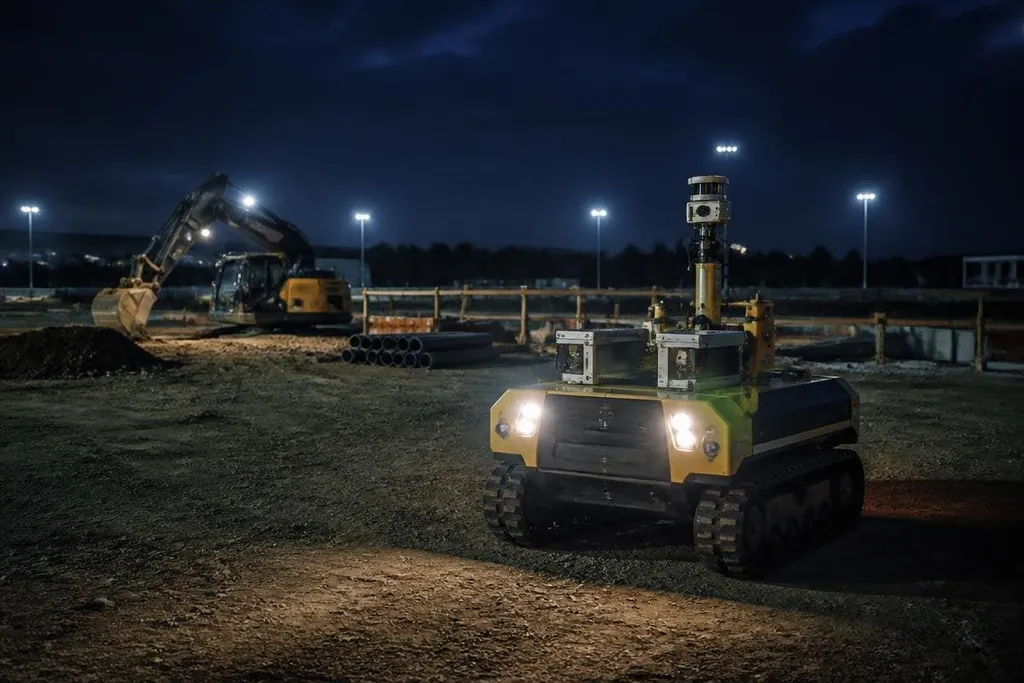
A construction robot can work overnight, but only on tasks that stay within a known area and can stop without help. An empty site removes many people from the work zone; it doesn't remove changing ground, weather, power faults, or equipment left in the robot's path.
- Overnight work fits repeatable tasks inside a marked work area
- Remote supervision still needs clear alarms and a safe stop
- The site must be checked again before people return
Where overnight work makes sense
Night work suits robots that repeat the same motion after the site team leaves. A machine moving materials along a fixed route, scanning a structure, or carrying out a defined layout task has a better chance than one expected to make broad decisions across an unfinished site.
The task must also have a clear end state. The robot should know where to park, how to shut down its tool, and what to do when its planned route is blocked. “Wait for help” is a valid response, but only if the machine can remain still without creating a hazard.
Construction sites change by the hour. A temporary wall may appear beside a route, a cable may cross the floor, or a delivery may leave material in a place the robot mapped earlier. That makes a fresh site check part of the work, not paperwork after it.
The safety problem after dark
Lighting affects cameras and depth sensors. Rain, dust, fog, reflective surfaces, and loose material can also reduce the quality of what the robot sees. A system that works in daylight may need different sensor checks before it runs through the night.
The robot needs a defined stopping zone around its path. That zone should account for the machine's size, speed, tool movement, and the distance it may travel after a fault is detected. Barriers help, but they don't replace a stop system that works when a sensor fails.
Power is another weak point. A robot that runs from a fixed cable needs a cable route that won't become a trip hazard or catch on moving equipment. A battery robot needs a safe charging area, enough charge for its task, and a plan for a low-battery stop.
Remote supervision has limits
Overnight autonomy rarely means nobody is watching. It usually means a person is available to review alarms, approve a restart, or send someone to the site when the robot cannot continue.
That person needs more than a video feed. They need the robot's location, the reason for the stop, the last sensor status, and a clear way to place the system in a safe state. If an alarm arrives without enough context, remote control turns a small fault into a site visit with poor information.
The response plan matters as much as the robot. A named person should know who can enter the site, who can isolate power, and who can inspect the machine.
That plan also needs facts about the machines under review. Robot24.com reports on construction robots can add named models, site conditions, and test dates before a manager lets the site run without staff overnight.
What remains unproven
The hardest question is not whether a robot can move at night. It is whether the full work cycle stays safe when the site changes and nobody is nearby to correct a small error.
A supplier may show a robot completing a task in a prepared area. That proves the motion works under those conditions. It doesn't prove the system can handle a new obstacle, a damaged marker, a lost network connection, or a person entering the work zone.
I'd approve overnight work only after the robot has shown safe stops and fault recovery on the actual site, not only in a prepared demonstration area. The test should include the route, tool, lighting, charging setup, and return-to-work process planned for the night shift.
Checklist before the night shift
Use these checks before assigning an overnight task:
- Mark the work zone and keep people, vehicles, and stored materials outside it.
- Run the planned route after the last site change, then record the map or markers in use.
- Confirm that the robot can stop safely after a blocked route, sensor fault, lost connection, or low battery.
- Place the charging gear and cable where other equipment cannot reach them.
- Give one person authority to stop the job and one clear process for site access.
- Inspect the area again before workers, deliveries, or other machines return.
Overnight construction robotics works best as a narrow extension of a supervised job, not as a replacement for site control. The deciding question is whether the robot can stop safely when the work area no longer matches its plan.